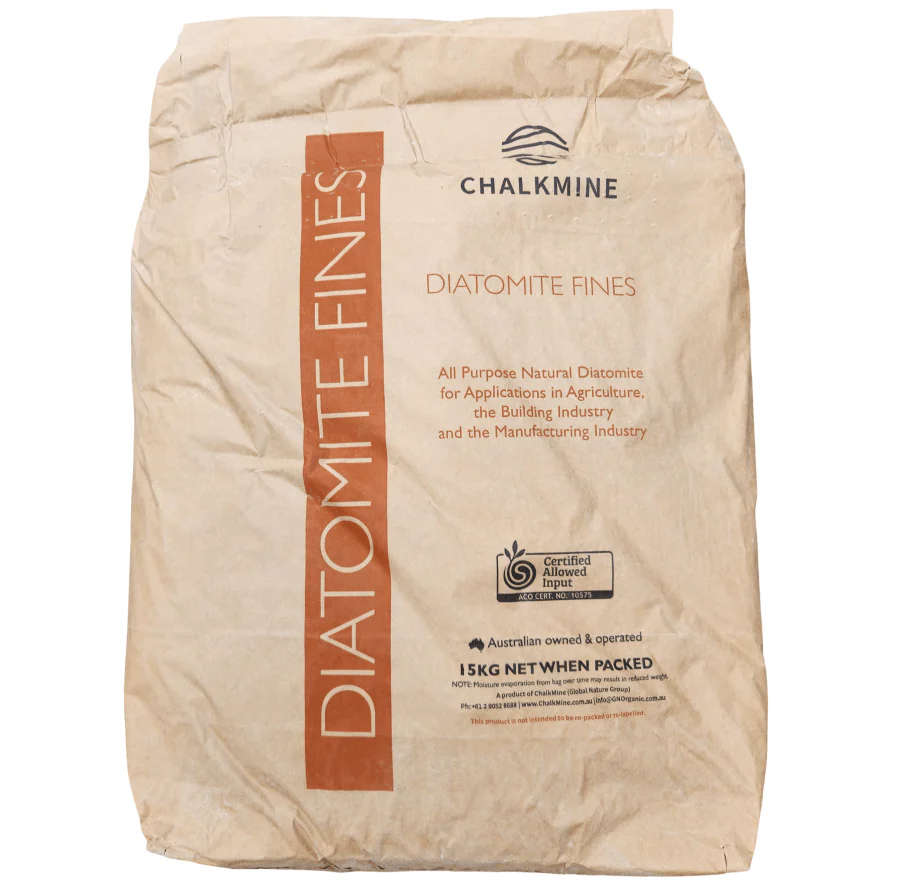
Diatomite Fines Powder: Organic Diatomaceous Earth
DE Fines is a high-performance diatomaceous earth sourced from a rare freshwater volcanic lake deposit in Junction View, Queensland.
At 90–92% amorphous silica, it significantly exceeds the industry average of 85% — delivering higher performance across every application.
It is the only diatomaceous earth in Australia certified as an organic input by Australian Certified Organic (ACO) — making it the natural choice for certified organic farming, livestock supplementation, and premium agricultural inputs.
Size Disclaimer: Only the 15kg comes in the original packaging. The small sizes are taken from an open 15kg bag and are supplied in a clear bag.
How is DE Fines used?
Livestock & Animal Health: A natural feed supplement with a long history of use across cattle, sheep, goats, alpacas, poultry, cats and dogs. Suitable for certified organic and chemical-free farming operations.
- Add at 2% of the feed ration by weight.
- Provides bioavailable silica and trace minerals in a readily absorbable form
- Widely used in the poultry industry as a natural nutritional supplement
Natural Pest & Insect Control: Works as a physical insecticide — microscopic silica particles damage insect exoskeletons, causing desiccation. No chemical residue, no risk of resistance developing, safe around animals and humans.
- Stored grain pest and weevil control.
- Poultry sheds and animal housing.
- Fungus gnat and soil insect control in propagation and nursery environments
Fertiliser Efficiency & Soil Health: As input costs fluctuate, DE Fines helps farmers extract more value from every dollar spent on fertiliser.
- Improves soil structure and water retention — reducing nutrient leaching and runoff.
- Strengthens plant cell walls via bioavailable silica — improving uptake efficiency of applied nutrients.
- Even distribution of carriers in fertiliser blends — reducing waste and improving application consistency.
- Reduces toxicity from excess nitrogen and phosphorus applications.
- ACO Certified — suitable for organic operators looking to reduce reliance on synthetic inputs
DE Fines does not replace nitrogen, phosphorus or potassium fertilisers — it helps your existing inputs work harder and go further.
Horticulture & Agriculture: Approved for use in organic farming programs.
- Soil amendment supplying plant-available silica to depleted soils
- Anti-caking carrier in fertiliser and feed blends
- Seed coating for improved germination and early silica uptake
- Enhances beneficial fungal activity in growing media
Our diatomite fines are the ideal Diatomaceous Earth (DE) product for supplementing chickens and stock feed. It has been used for many years by the poultry industry and has a long and successful history of use with cattle, sheep, goats, alpacas, as well as cats and dogs.
About Diatomite (DE) for Poultry:
Diatomaceous Earth is claimed to have numerous health benefits for your chickens. While some are not scientifically proven, many poultry keepers have experienced the following benefits:
- Clearing internal parasites such as worms.
- The strengthening of the chicken's cells occurs as they absorb the silica from the diatomaceous earth.
- Protecting chickens against fleas and flies.
- Drying up the moisture from their droppings.
- Getting rid of lice and mites.
- Strengthening the chicken's feathers gives them shine.
- Gives the eggs firmer shells.
What we know is that diatomaceous earth contains lots of great trace minerals when fed to chickens, so it’s beneficial in that regard.
Feed Rates:
According to the book "Going Green Using Diatomaceous Earth: How to Tips" (See Below), it suggests the following daily application rate: 2 to 5% of DE per weight of feed ration.
Other Uses for Diatomite Fines:
Fine diatomite can also be used as a filler, particularly where a lightweight inert filler is required. It is frequently added to paints, varnishes, lacquers, paper, insecticides, plastics, asphalt, fertilisers, welding rods, printing inks, sealing compounds, explosives and matches.
The finer diatomite grades are as good as or even more absorbent than Kleensorb. Fine diatomite absorbs more than 200% its weight in water.
The low thermal conductivity of diatomite makes it one of the best insulators over a wide range of temperatures. It is also used as a mild abrasive. As a powder, paste or suspension, it is employed in metal and car finish polishes, toothpastes, powders, soaps, scouring compounds and match heads.
Diatomite is used in the manufacture of alkaline earth silicates and is also important in the making of pigments, ceramic glazes and as a pozzolanic component in concrete.
An important use of diatomite is as a support or carrier for catalysts, as a promoter of reactions, in emulsion breaking, in settling out processes, and in foundry operations.
Diatomite is gaining increasing use in agriculture. For a long time, it has been used as an addition to ammonium nitrate fertilisers to prevent caking and ensure even spreading. It is important as a carrier for other agricultural products, particularly fertilisers. Our own manufactured product, Molodri, is an example of the effectiveness of diatomite in this capacity. The use of diatomite in combination with other biogenic materials is a key to its future applications, providing benefits for both plants and animals.
Disclaimer & Australian Registered Uses: Please note that Diatomaceous Earth is not registered in Australia for many of the international and other uses listed above. In Australia its range of registered uses is limited to the following: For the control of various stored product insect pests in farm-stored feed grain, farm-stored seed grain, grain for human consumption not handled by or delivered to bulk grain handling authorities, harvesting and other grain-handling machinery, grain bins, silos and other storage facilities, food processing and warehouse facilities as per directs for use.
Current Australian research and product development are focused on:
- Bed bugs.
- Poultry pests: Red mite, Darkling beetle and Lice.
- Internal Parasites of stock: poultry, goats and sheep.
Health & Safety Disclaimer: Please read and follow the instructions on the product's packaging and only use as directed. Please follow the instructions on the product packaging above all other information, even above information on this page that may have errors or might not apply to your situation. We suggest using an N95 mask or similar when applying any diatomaceous product and avoiding breathing in the powder as much as possible.
Frequently Asked Questions:
Q. What is the main difference between Diatomite Fines and Diatomaceous Earth, and is Diatomite Fines suitable as an insecticide?
A. Both are Diatomaceous Earth products, but the Diatomite Fines is coarser and not as fine as the regular DE, so the Diatomite Fines is less effective as an insecticide. Since Regular DE is finer, it makes it microscopically sharper and hence more damaging to insects.
Q. What is the average particle size of this Diatomite Fines?
A. According to the manufacturer, the average particle size is 30 microns.
Q. Is this Diatomaceous Earth food grade?
A. This product is food-grade (but is not registered as food grade) and is made from the same Diatomaceous Earth material that Absorbacide is. Absorbacide is registered as food-grade, as it's more suited for food-grade uses, such as killing insects in grains, etc.
Original: $14.99
-65%$14.99
$5.25Product Information
Product Information
Shipping & Returns
Shipping & Returns
Description
DE Fines is a high-performance diatomaceous earth sourced from a rare freshwater volcanic lake deposit in Junction View, Queensland.
At 90–92% amorphous silica, it significantly exceeds the industry average of 85% — delivering higher performance across every application.
It is the only diatomaceous earth in Australia certified as an organic input by Australian Certified Organic (ACO) — making it the natural choice for certified organic farming, livestock supplementation, and premium agricultural inputs.
Size Disclaimer: Only the 15kg comes in the original packaging. The small sizes are taken from an open 15kg bag and are supplied in a clear bag.
How is DE Fines used?
Livestock & Animal Health: A natural feed supplement with a long history of use across cattle, sheep, goats, alpacas, poultry, cats and dogs. Suitable for certified organic and chemical-free farming operations.
- Add at 2% of the feed ration by weight.
- Provides bioavailable silica and trace minerals in a readily absorbable form
- Widely used in the poultry industry as a natural nutritional supplement
Natural Pest & Insect Control: Works as a physical insecticide — microscopic silica particles damage insect exoskeletons, causing desiccation. No chemical residue, no risk of resistance developing, safe around animals and humans.
- Stored grain pest and weevil control.
- Poultry sheds and animal housing.
- Fungus gnat and soil insect control in propagation and nursery environments
Fertiliser Efficiency & Soil Health: As input costs fluctuate, DE Fines helps farmers extract more value from every dollar spent on fertiliser.
- Improves soil structure and water retention — reducing nutrient leaching and runoff.
- Strengthens plant cell walls via bioavailable silica — improving uptake efficiency of applied nutrients.
- Even distribution of carriers in fertiliser blends — reducing waste and improving application consistency.
- Reduces toxicity from excess nitrogen and phosphorus applications.
- ACO Certified — suitable for organic operators looking to reduce reliance on synthetic inputs
DE Fines does not replace nitrogen, phosphorus or potassium fertilisers — it helps your existing inputs work harder and go further.
Horticulture & Agriculture: Approved for use in organic farming programs.
- Soil amendment supplying plant-available silica to depleted soils
- Anti-caking carrier in fertiliser and feed blends
- Seed coating for improved germination and early silica uptake
- Enhances beneficial fungal activity in growing media
Our diatomite fines are the ideal Diatomaceous Earth (DE) product for supplementing chickens and stock feed. It has been used for many years by the poultry industry and has a long and successful history of use with cattle, sheep, goats, alpacas, as well as cats and dogs.
About Diatomite (DE) for Poultry:
Diatomaceous Earth is claimed to have numerous health benefits for your chickens. While some are not scientifically proven, many poultry keepers have experienced the following benefits:
- Clearing internal parasites such as worms.
- The strengthening of the chicken's cells occurs as they absorb the silica from the diatomaceous earth.
- Protecting chickens against fleas and flies.
- Drying up the moisture from their droppings.
- Getting rid of lice and mites.
- Strengthening the chicken's feathers gives them shine.
- Gives the eggs firmer shells.
What we know is that diatomaceous earth contains lots of great trace minerals when fed to chickens, so it’s beneficial in that regard.
Feed Rates:
According to the book "Going Green Using Diatomaceous Earth: How to Tips" (See Below), it suggests the following daily application rate: 2 to 5% of DE per weight of feed ration.
Other Uses for Diatomite Fines:
Fine diatomite can also be used as a filler, particularly where a lightweight inert filler is required. It is frequently added to paints, varnishes, lacquers, paper, insecticides, plastics, asphalt, fertilisers, welding rods, printing inks, sealing compounds, explosives and matches.
The finer diatomite grades are as good as or even more absorbent than Kleensorb. Fine diatomite absorbs more than 200% its weight in water.
The low thermal conductivity of diatomite makes it one of the best insulators over a wide range of temperatures. It is also used as a mild abrasive. As a powder, paste or suspension, it is employed in metal and car finish polishes, toothpastes, powders, soaps, scouring compounds and match heads.
Diatomite is used in the manufacture of alkaline earth silicates and is also important in the making of pigments, ceramic glazes and as a pozzolanic component in concrete.
An important use of diatomite is as a support or carrier for catalysts, as a promoter of reactions, in emulsion breaking, in settling out processes, and in foundry operations.
Diatomite is gaining increasing use in agriculture. For a long time, it has been used as an addition to ammonium nitrate fertilisers to prevent caking and ensure even spreading. It is important as a carrier for other agricultural products, particularly fertilisers. Our own manufactured product, Molodri, is an example of the effectiveness of diatomite in this capacity. The use of diatomite in combination with other biogenic materials is a key to its future applications, providing benefits for both plants and animals.
Disclaimer & Australian Registered Uses: Please note that Diatomaceous Earth is not registered in Australia for many of the international and other uses listed above. In Australia its range of registered uses is limited to the following: For the control of various stored product insect pests in farm-stored feed grain, farm-stored seed grain, grain for human consumption not handled by or delivered to bulk grain handling authorities, harvesting and other grain-handling machinery, grain bins, silos and other storage facilities, food processing and warehouse facilities as per directs for use.
Current Australian research and product development are focused on:
- Bed bugs.
- Poultry pests: Red mite, Darkling beetle and Lice.
- Internal Parasites of stock: poultry, goats and sheep.
Health & Safety Disclaimer: Please read and follow the instructions on the product's packaging and only use as directed. Please follow the instructions on the product packaging above all other information, even above information on this page that may have errors or might not apply to your situation. We suggest using an N95 mask or similar when applying any diatomaceous product and avoiding breathing in the powder as much as possible.
Frequently Asked Questions:
Q. What is the main difference between Diatomite Fines and Diatomaceous Earth, and is Diatomite Fines suitable as an insecticide?
A. Both are Diatomaceous Earth products, but the Diatomite Fines is coarser and not as fine as the regular DE, so the Diatomite Fines is less effective as an insecticide. Since Regular DE is finer, it makes it microscopically sharper and hence more damaging to insects.
Q. What is the average particle size of this Diatomite Fines?
A. According to the manufacturer, the average particle size is 30 microns.
Q. Is this Diatomaceous Earth food grade?
A. This product is food-grade (but is not registered as food grade) and is made from the same Diatomaceous Earth material that Absorbacide is. Absorbacide is registered as food-grade, as it's more suited for food-grade uses, such as killing insects in grains, etc.